Tuesday, 16 January 2018

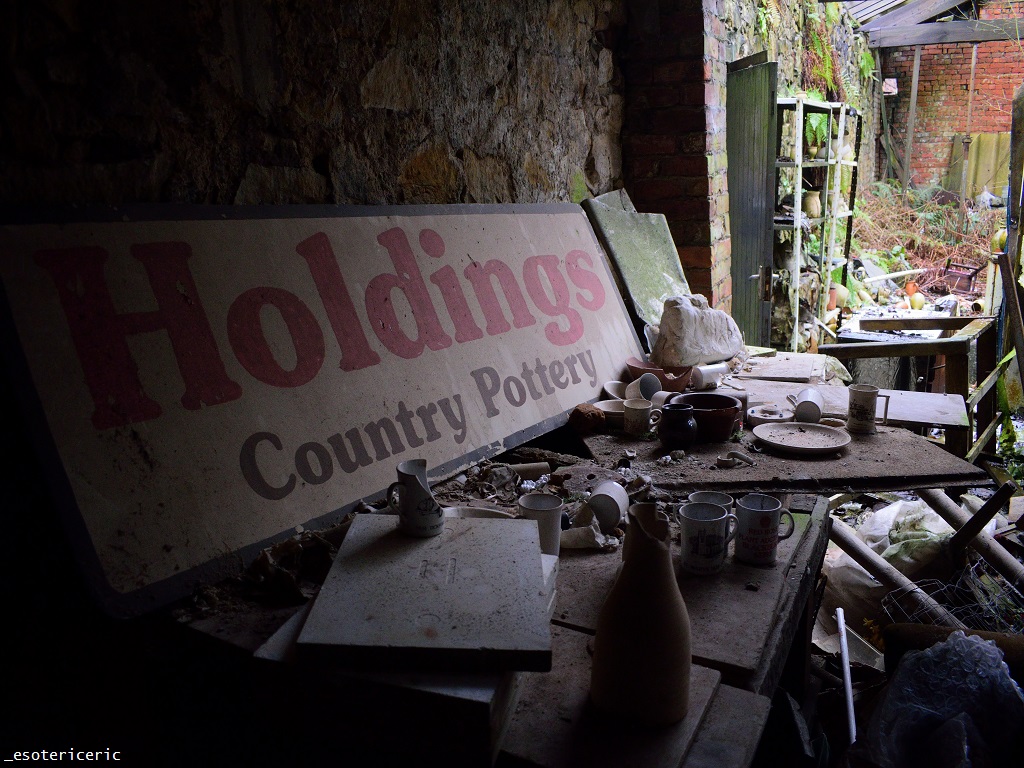
Holdings Pottery, Oswaldtwistle

History

Holding's Country Pottery was originally founded in 1842 by James Holding.
 
For a comprehensive history see:
 
http://www.jarrelook.co.uk/Urbex/Holdings%20Brothers%20Pottery/Holdings_Pottery.htm
 
Esoteric Eric


Wednesday, 10 January 2018

Porter Brook Culverts, Sheffield

History

The Porter Brook is a river in the City of Sheffield, England descending over 1,000 feet (300 m) from its source among the sedge grass on Burbage moor behind a small farm on Hangram just inside the Peak District National Park in the west of the city at Clough Hollow, near the village of Ringinglow. Porter Brook derives its name from its brownish colour, similar to the colour of Porter, a brownish discolouration obtained as it passes over iron-ore deposits on its course from the source.
 
From here it flows eastward through Porter Clough through Mayfield Valley to the first of the remaining mill dams. Beyond Forge Dam, where the Porter is defined as a main river, the brook makes its way through Endcliffe Park to Hunter's Bar, before running between Ecclesall Road and Sheffield General Cemetery, past the former Wards brewery. The section of the river from Renton Street, near to the location of Sharrow Forge (No. 15), is now built over running through culverts beneath the intersection of London Road and Eyre Street. It re-emerges by Eyre Street after which it flows alongside Mary Street, beneath the bridge on Matilda Street and behind the BBC offices on Shoreham Street, passing beneath Leadmill Road towards the culvert at Cross Turner Street outside Sheffield Station. It meets the subterranean River Sheaf beneath the Station.
 
Source:
https://en.wikipedia.org/wiki/Porter_Brook
 
Esoteric Eric


Monday, 8 January 2018

Atmosphere, Barnsley

History

What looks to be a modern storm/ surface water run off in to the River Dearne. A tight squeeze and a soaking in to roughly 4ft RCP with two choices, left and right, with several smaller side pipes entering along the way.
 
The left pipe leads a short way to a 2ft RCP.
 
The right pipe breaks halfway to outfall the main source of water in here which was entering at a decent speed, not too sure where this is coming from. Following this the 4ft RCP continues up an incline and ends in a room with a small pit in the middle for collecting the water running in from two further pipes built higher in to the wall.
 
Short and sweet with sketchy levels of O2 towards the end.
 
Esoteric Eric


Thursday, 4 January 2018

Branston Depot, Branston, Staffordshire

History

Branston Depot is a former ordnance facility at Branston, Staffordshire.
 
The site was originally conceived as the National Machine Gun Factory but by the time construction was completed in November 1918 the First World War was over and no machine guns were ever manufactured there. Crosse & Blackwell briefly used the factory for producing pickle (Branston Pickle) between 1920 and 1925 and the Branston Artificial Silk Company produced Rayon there between 1927 and 1930. During the Second World War a major ordnance facility known as the Branston Depot was established on the site: the depot closed in 1961 when operations moved to Bicester. Parts of the site were used for the storage of components for Royal Ordnance between 1964 and 1975 and more recently parts of the site have been developed for housing.
 
Source:
https://en.wikipedia.org/wiki/Branston_Depot
 
Esoteric Eric